Discovery and Synthesis
Find the paper you didn’t know to search for.
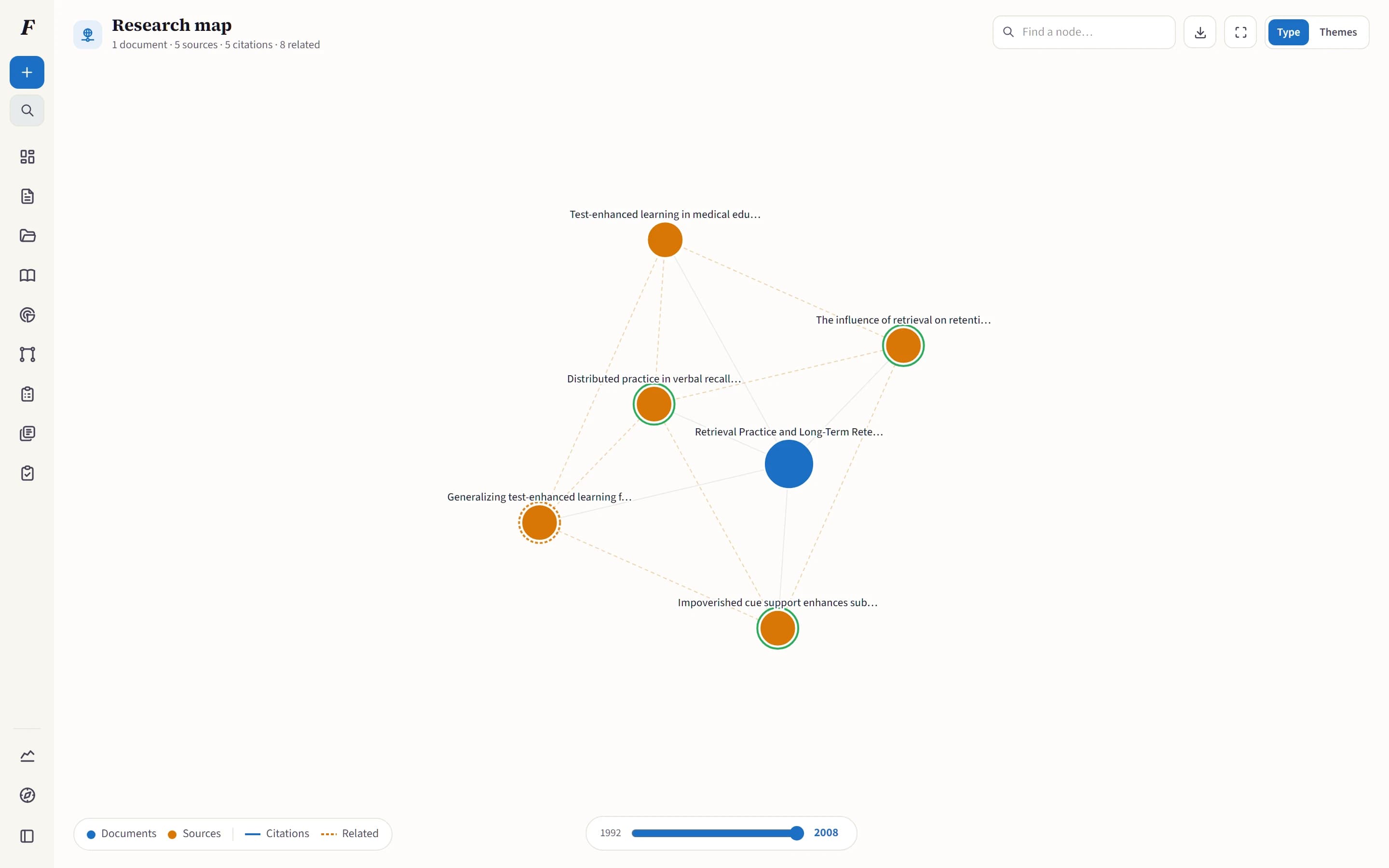
A keyword search never surfaces everything. From any result, follow its citations forward and back: the work that builds on it, the work it stands on, until the picture is complete. Then turn the pile into a structured review.
Search and the citation graph: 40 a day on Scholar, unlimited on Fellow and Chair.The Synthesizer: Fellow and Chair.Every plan, compared
A keyword search returns a list. The citation graph returns the shape of the literature: what a paper stands on, what builds on it, ranked by influence rather than by how well it matched your words.
The questions that decide it.
Short answers, in the product’s own terms.
Search casts the wide net: one query across every source at once. Discovery is what comes next: from a paper you found, follow its citations forward and back to reach the work a keyword search never surfaces, then structure it into a review.
OpenAlex, keyless and open. From any paper with a DOI, Folio pulls the works that cite it and the works it references, ranked by citation count so the influential ones surface first.
No. The Synthesizer can only cite the real results Folio retrieved, and the review document’s synthesis matrix is a structured scaffold filled from your sources; Folio does not fabricate cells or summaries.
Searching and following the citation graph are free. The AI Synthesizer is part of the Fellow and Chair plans.
Every image on this page is a capture of the product running on fictional data. How data is protected
Find everything. Miss nothing.
Searching and following the citation graph are free. Start now.
Free to start · No credit card · Export everything · No ads